
The road out of Bangkok towards Cha-am thins out once you are past the last mall, and this morning I had it to myself. I have ridden it a few times now, out to an engagement I took over this year. I know the corners already. What I have not shaken is the feeling that comes with them, because it is not new. I had it first a long time ago, walking into a dead man's job.
A man I never met had died on a road in the west of the country, three weeks before Christmas, and that was how I got it.
I was five years into a company I wanted to leave. The work was fine. The place was not. Decisions went to whoever had been there longest, not to whoever was right, and age kept winning arguments that qualification should have won. I had built good relationships with the suppliers I dealt with, the people you would now call a network, and through them I heard that a specialist's desk had come open at the mother company, and the hard way it had come open.
Something in me moved before I could explain it. I said, put me in contact with the headquarters. I might be the person for that desk.
I landed it. I packed up and moved to a bigger city, the whole thing arranged inside two weeks, and I started a few days before Christmas, in the chair of a man who was not coming back.
The first week
What I had not understood was that the larger company was the smaller one wearing a better suit. The same politics. The same seniority deciding things that competence should have decided. My first week was meetings. Only meetings. At the end of it I had produced nothing at all, and I quit.
I did not expect what happened next. The CEO was also new, brought in to do to this place the thing I had not yet found the words for. He refused the resignation. He asked me what it would take.
What it took was leaving the structure completely. I came back a few days later as a freelancer on a US contract, a specialist with the authority to order what I needed, reporting to him and to nobody in between. It was not a step up any ladder. There was no ladder worth climbing. It was something better than a promotion. It was room.
He was a particular kind of man. If a phone rang more than three times with nobody answering, you heard him across the whole floor. He walked into meetings he had not been invited to and went around the table, one person at a time. Part of the problem, or part of the solution. If you were neither, he wanted you out of the room. He was about thirty-five years older than me and we wanted the identical thing, a European company that actually moved, that did not drown itself in its own procedure. It was 1995. On the other side of the world garages were turning into companies and the word startup was beginning to travel. You could feel the weather changing before you could see it.
What the dead man left
When the meetings stopped I finally did the thing I had come there to do. I read his work.
It was good. I want to be clear about that, because the lazy telling makes him the cautionary tale, and he was not one. He was a capable developer who had built real things that ran. What he had not done was write any of it down, and nothing in that building told him he had to. There were barely backups. This was 1995. There was no GitHub, no second place a person could go to see what you had been thinking, only the machine in front of you and whatever was in your head.
And the people who had learned the trade in that era learned it on mainframes, where documentation was either a cathedral, a shelf of formal binders no one ever opened, or it was nothing at all. The subsidiary had taken on the newer work and never inherited the old discipline that used to come with it. So the way he worked was not a failure of character. It was the standard of the room he had been trained in.
The real problem was simpler and worse than bad documentation. He was gone, and there was no one to ask. The code could tell me what it did. It could not tell me why. And why was the only thing I actually needed.
The year we gave up
We decided to throw it away. A year of development, set down, and rebuilt from the beginning.
The easy reading is that this is a story about documentation. Write it down and you do not lose the year. That reading is wrong, and the reason it is wrong is the part worth your time.
The year was not lost because the code was unreadable. It was lost because nobody in the building could tell me what the business had actually ordered. The requirements were scattered, half of them living in people's heads, a good share of them never agreed in the first place. Then the new CEO changed the direction, which changed what the thing was even for. And beneath all of it the ground was moving. Offices were going from analogue to digital across that whole decade. What was true for a customer in spring was quietly false by autumn.
So even a perfectly documented system, backed up twice a day, would have needed tearing up. The documentation would have saved me the reading. It would not have saved me the rebuild. His silence did not cost us the year. A market that would not hold still did.
That is the part people do not want to hear, because the lesson everyone wants is write it down and you are safe. You are not. You are only slightly less lost.
Good enough, and then gone
I built the structures the second time around. Documentation rules, procedures, a way for a second person to pick up a thing without holding a séance. But not the cathedral. I had just run from a company that mistook its process for its product, and I was not about to build that again. Good enough was the standard. Enough to protect the company if someone walked under a bus, never so much that the protecting became the work. More than I had inherited. Lighter than what I had left.
And then I went out to the customers.
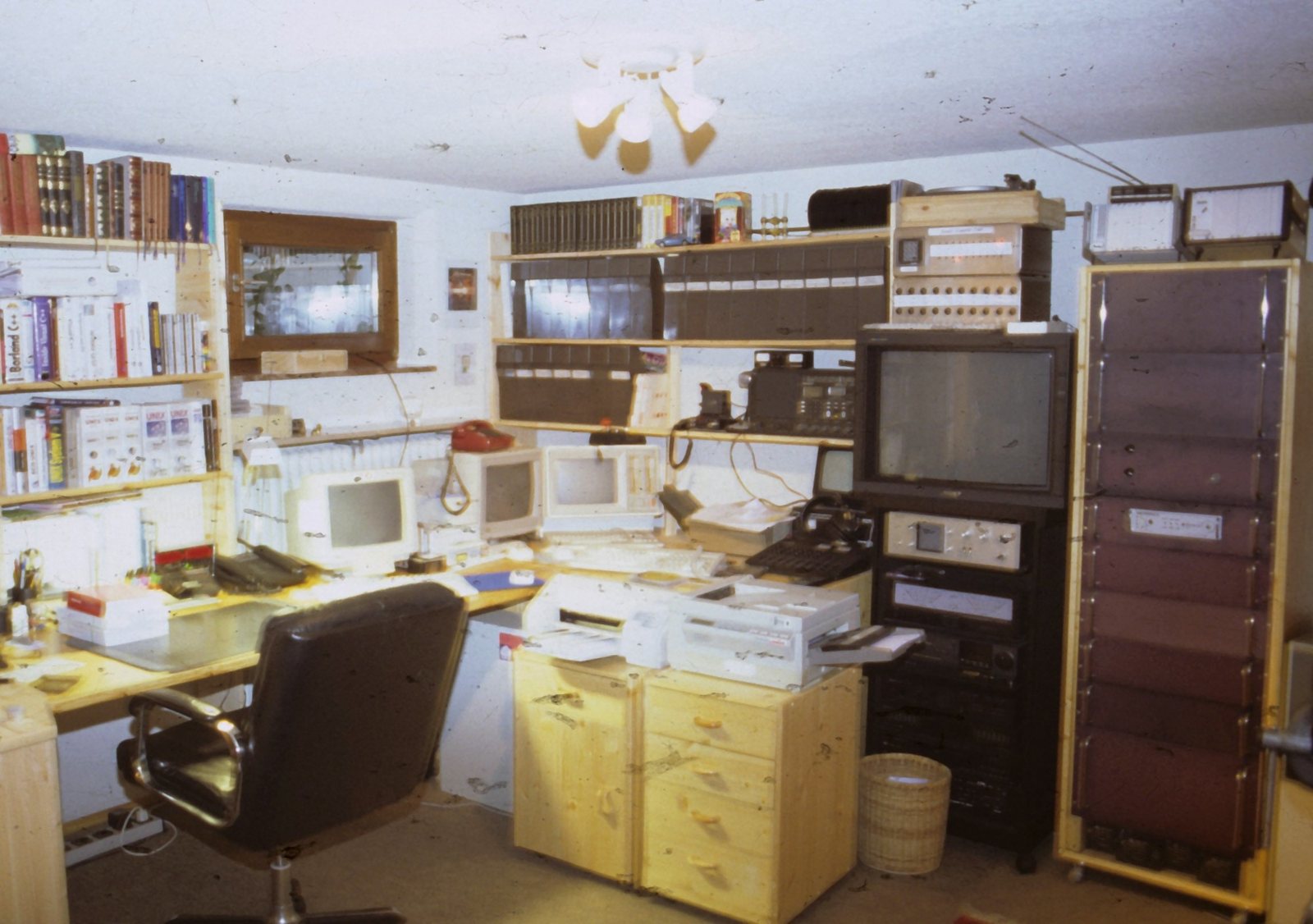
This is the part of the job I still remember in my hands. The company's biggest clients had problems the product alone could not solve, almost always buried somewhere in their own systems. So they sent me. Token ring and Ethernet arguing over the same floor. Coax giving way to twisted pair. Multiplexers, analogue leased lines, a rack of modems blinking through the night to move an amount of data that now arrives before you finish saying it. Fibre, if the client was lucky and rich, strung between two buildings like a nerve. No internet underneath any of it to catch you. You went, you looked, you worked out what they were really trying to do, and you made it run.
Every one of those standards was the future on the day I learned it. Every one of them is a relic now. I did not keep a single system I built in that decade. Nobody expected me to.
Still the same move
I think about that man more than I expected to, the one whose chair I took. He did the work well and the work is gone, and almost none of that had anything to do with him. You can do everything right, write it down, back it up, hand it over clean, and the market can still decide the whole thing is finished before you are.
The tools have changed past all recognition since. In 1995 the hard problem came as modems and leased lines. This morning it comes as AI, and the shape is identical. Every capable team I see right now is good, better than they can see. They are not behind. They are drowning. A new model, a new tool, a new thing that changes everything lands every few hours, and somewhere in the noise the actual work stopped. My job this time is not to build it for them. It is to help them hear themselves think again, and get back to the doing.
I can do that because I never stopped doing the work myself. I advise now where I once would have had my hands all the way in, but I still build, still break things, still sit with the new tools until I know where they lie to me. That is the only reason the advice is worth anything. The day you guide from memory, from the last war, you have become the thing you were brought in to fix.
The move is the one I found in 1995 and never put down. Get to the why. Build the good-enough version. Hold it loosely, because you are going to throw it away. It was true in that cold office and it is true now.
So I stopped trying to build things that last. I build things that are honest about where they are, and I stay ready to start over. It is not a comfortable way to work and I would not sell it to you as one. The people I watched get hurt the worst usually had their backups. What sank them was believing the thing they had built was the place they had arrived.

There is no arriving. I am about to park the bike and spend a day helping a room of capable people believe that, which is either the hardest part of this work or the best one. After all this time I still cannot tell which.