A founder asked me last month what happens when my internet goes down.
He meant it kindly. It is the question people ask when they are quietly wondering whether someone who works from Bangkok is a serious proposition for a company in Europe. Whether the distance is a risk. Whether, when something urgent lands, the person on the other end will simply not be there.
It is a fair thing to wonder, and it deserves a real answer rather than reassurance. The honest answer is that my ability to work does not depend on any single thing that can fail. Not a room, not a machine, not a line, not a bag on a carousel. It came from twenty years of the work breaking in small ways and me removing whatever broke, one dependency at a time.
Every piece solved a problem
I did not set out to build an unusual setup. I set out to stop losing mornings, and this is what was left after two decades of it.
The screens tell the story in miniature. For years I ran a single 21-inch monitor, not for lack of ambition but because a second screen then meant a dedicated graphics card and drivers that fell over, and I cannot lose a morning to a display that will not wake up. Around 2012 USB display adapters made extra screens cheap and stable, so I ran three and kept the thing I was building and the thing I was building against in view at once. Around 2017 one high-resolution panel could hold what used to take three, so I dropped back to one Retina laptop and one 27-inch 4K monitor. More pixels, fewer things to carry.
Then travel exposed the flaw none of it had at home. A desk does not come with you. In a hotel or a client's office I was back to a laptop screen, and the problem was never resolution, it was physical surface, which you cannot pack. I had solved the problem perfectly in exactly one place.
The move that mattered
In 2022 I stopped trying to make the travelling screen bigger and started depending on it less.
My week splits cleanly. Seventy to eighty percent is running things: meetings, email, Slack and Teams, research, writing, reviewing, interviewing, going through the numbers that say whether the thing is healthy. None of that needs a desktop operating system or a wall of screens. It fits on an iPad with a keyboard and its own connection. The other twenty to thirty percent genuinely needs macOS: a terminal, development, agentic AI work, evaluating models, compiling firmware, testing an MVP, cloud admin. That does not happen on a tablet.
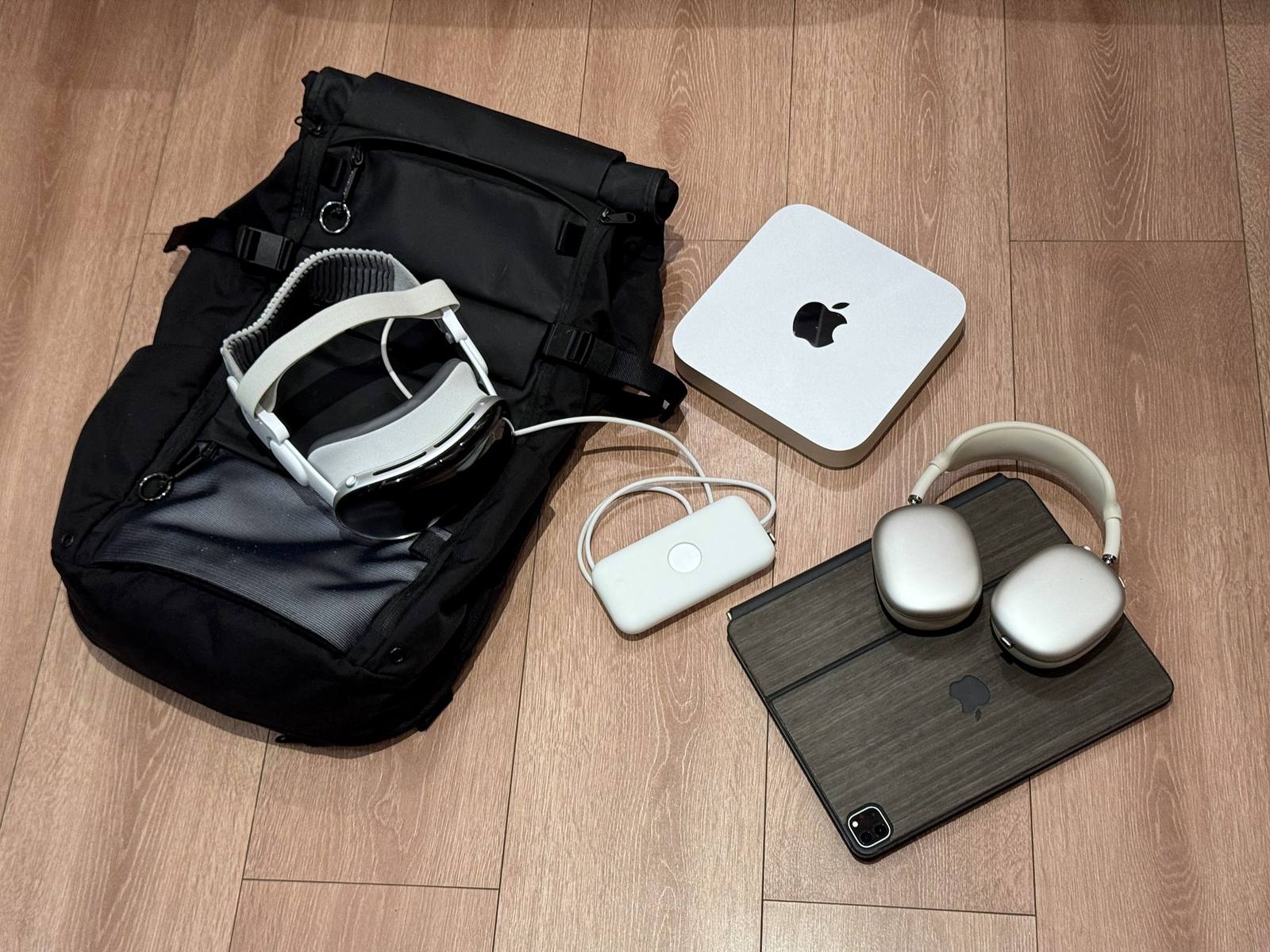
So I stopped asking one machine to do both and carried two that each did one well. An iPad for running things, a Mac mini with the Pro chip for the work that needs a real machine. People assume the mini is the weak point and it is not: most of the heavy compute is not local anyway, the models run on cloud instances and the machine drives them. What the mini gives up is a built-in screen and a battery. The screen I had already decided to stop carrying, and the headset would later answer it. The battery is the trade I accepted.
The iPad has its own SIM, on a different carrier from my iPhone, so the two never depend on the same network. When one is down or dead inside a building, I tether the iPad to the phone instead of hunting for a password. I prefer that to café or hotel wifi, which opens the door to more kinds of attack than most people want to think about, and on the day I cannot avoid public wifi, nothing goes over it without a VPN. Redundancy and security turn out to be the same decision.
There was also a side effect I did not expect, worth as much as the portability. Splitting the work across two machines forced focus. On one laptop every kind of work is always there, which sounds like freedom and is the opposite: you sit down to write and the code is right there, you sit down to build and the inbox is right there, and you end the day having touched everything and finished nothing. When the writing lives on the iPad and the building on the mini, the machine in front of you decides the task. Having a place is most of what focus is.
The dependency that was left
Two machines still left one weak point on the road: the mini has no screen, so it needed to find one. A coworking monitor, a hotel TV, a screen I talked someone into lending me. That worked most of the time. Sometimes there was nothing to borrow, and I was down to the iPad whether the task wanted it or not.
In 2024 the Vision Pro closed that gap. Not by changing everything, the version of this story I want to avoid, but by removing exactly one dependency: the screen I did not control. Connect the mini to the headset and a hotel room becomes the multi-screen desk I gave up in 2017, without a monitor in the bag. And the headset runs on its own, so it is a third computer, not just a display.
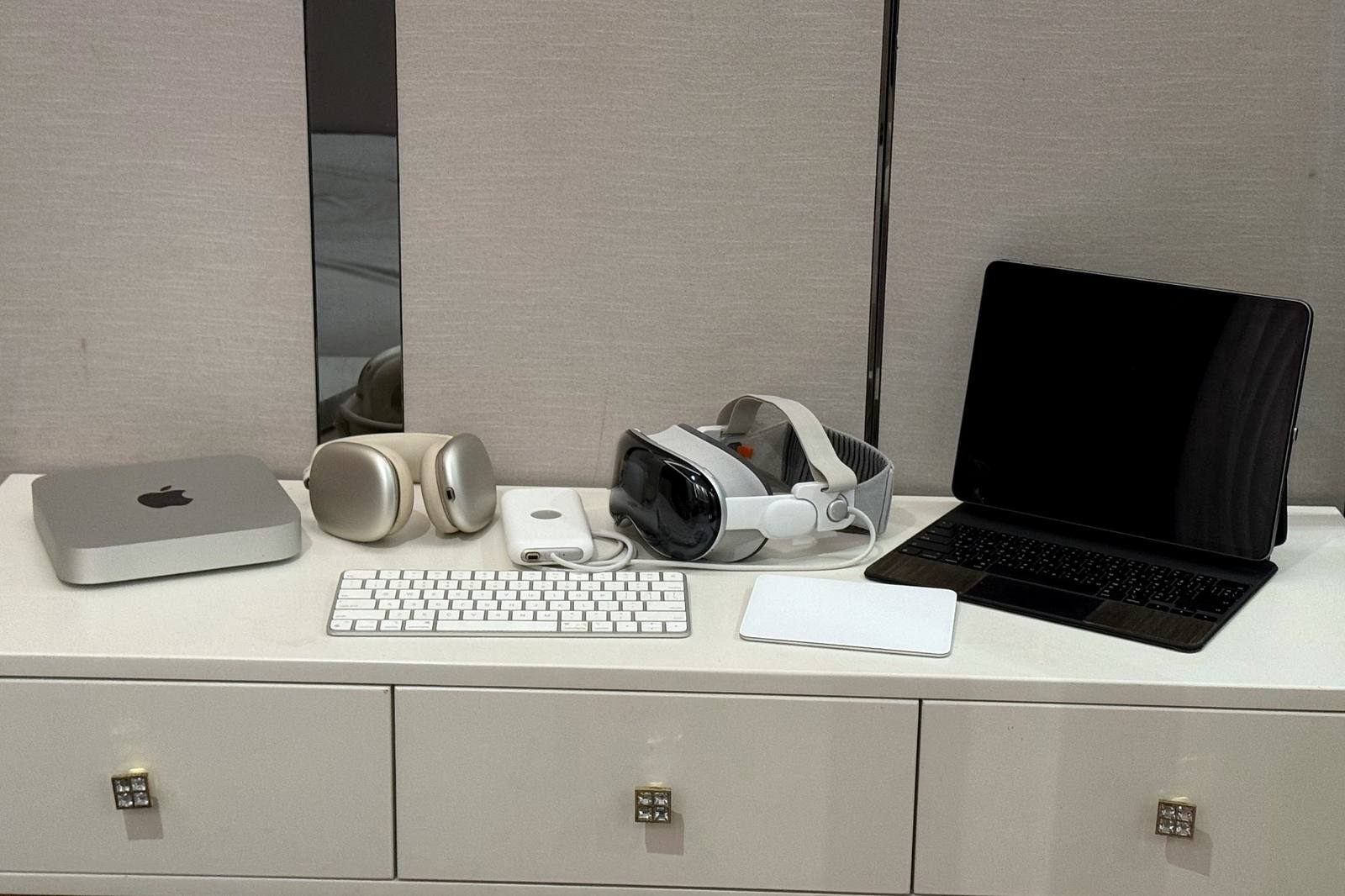
If the headset fails, a capture card turns the iPad into the mini's display, smaller, but enough to finish the day. The weak point has two fixes, not one.
So this is not one machine, and not two. It is three, and each can carry part of what the others do. Not all of it. If the mini dies in a hotel room, the headset is still a working machine, limited, not macOS, but working. That is partial redundancy, not three copies of the same thing, and it is enough. One laptop is a single point of failure with a good screen.
The whole setup runs about a kilo more than a large laptop, and that kilo is the first thing some people want to weigh. Here is what it buys: three machines instead of one, a full working environment anywhere, and no single device whose failure ends the day.
On the road
Take an ordinary trip. I leave Bangkok in the evening, fly out around 2am, land in Dubai at 6am. Early check-in, shower, breakfast, and I am in the meeting. A few days of it, then I go straight from the last meeting to the airport, fly back overnight, and I am at my desk by 10 the next morning. Clean night flights both ways, no wasted days, and the work never stopped because it was in the cabin with me.
My office does not go in the hold. The clothes are the same everywhere, black shirt, jeans, black sneakers, so there is little to pack. For a few warm days, one carry-on does it. For six weeks through colder places I check a bag for the warm layers, like everyone else. If that bag goes missing I have lost clothes, which is annoying and replaceable. My work was never in it. Plenty of people I know have stood at a belt hoping their bag turns up with the laptop inside it unbroken. That is the dependency I designed out.
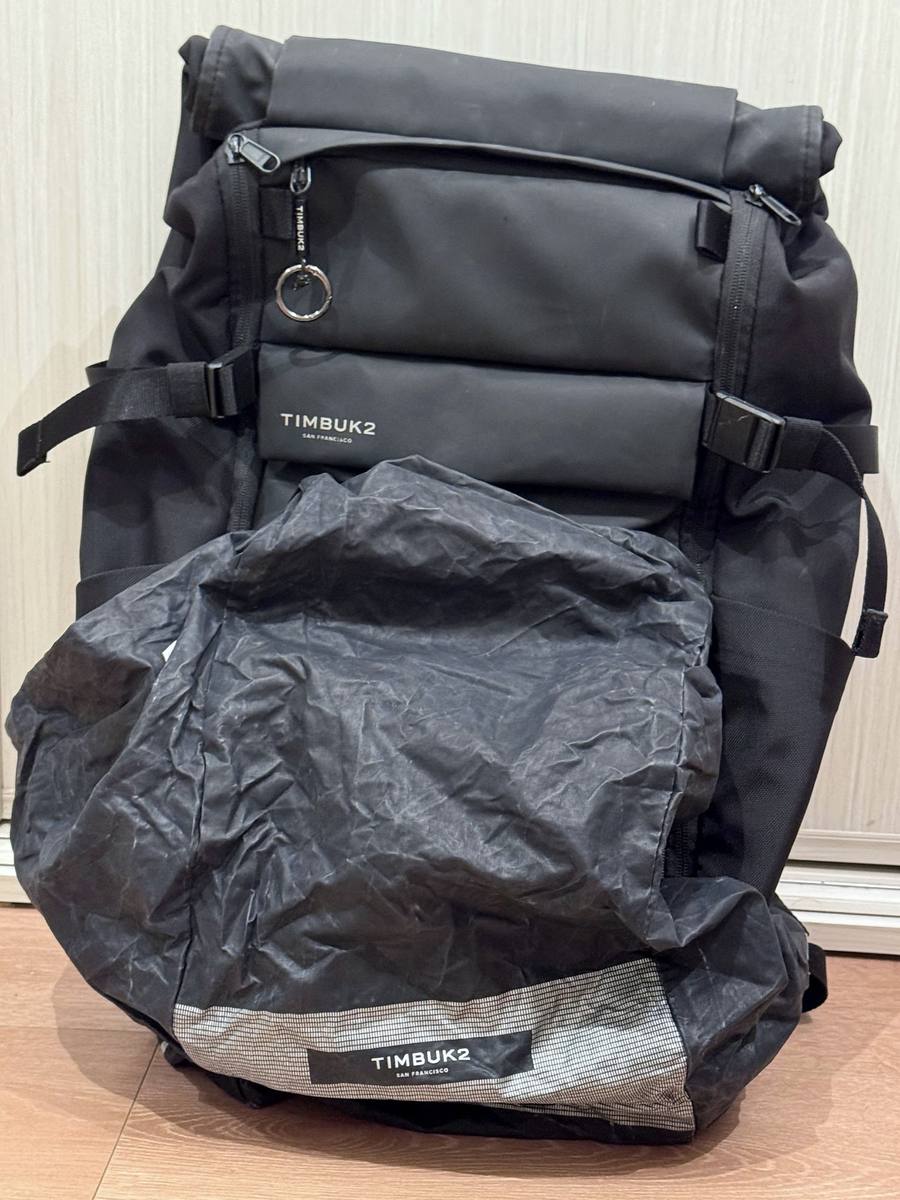
The kit is built the same way. The bag is a plain black Timbuk2 with a rain cover folded into the base, which sounds trivial until you have crossed a Bangkok forecourt in monsoon season with your whole office on your back. The iPhone and the iPad charge through add-on magnetic tips, not Apple's MagSafe, so a cable caught in a café comes away and the device stays on the table. None of it is precious. It is one instinct applied over and over: assume the common failure will happen, and make it a shrug instead of a crisis.
The one time it went properly wrong is the story I trust most, because I caused it. I flew to Dubai and forgot the mini's power cable, with a presentation due that day. It takes a standard cable sold almost everywhere, so a short taxi ride and I was working again within half an hour. The setup did not stop me forgetting the cable. It made forgetting it a thirty-minute problem instead of a lost day.
What else can go wrong
A setup like this invites the obvious follow-up questions, and they are the right ones. They are the same questions I ask about a client's systems, so it would be strange not to ask them about my own.
What if it is stolen? The phones do not travel in the bag, they travel in my pocket, so one theft does not take everything at once. The iPhones and the iPad are covered for theft under AppleCare One. The mini and the headset are not, so for those I accept the cost: a replacement is cheaper than the days I would lose without one. Because nothing important lives only on a device, once a replacement is in my hand it is working within a few hours, and I know where to get one in every city I regularly work from. The insurance pays for some of the hardware. The backups are what actually save the day.
What if someone gets into my account? This is the one I take most seriously, because it is the failure that does not announce itself. It is the real job of the second iPhone. It runs on its own Apple ID, tied to none of my other devices, with its own backup, and it holds the authentication, the codes and keys that guard everything I can reach, along with what I need to restore my main account if that one is ever compromised or lost. The recovery keys are stored physically apart from both, reachable only after authorisation. I do not use SMS as an authentication factor, so a SIM swap alone gets nobody my codes. Breaking into my everyday machine or account does not hand anyone the way back in, because that lives somewhere else.
What if the power goes? At the base in Bangkok the mini sits on a UPS. In a hotel it stops with the power, but the iPad, the phones and the headset run on their own batteries, so an ordinary outage costs me the macOS work for a few hours, not the day.
What I cannot remove, I make recoverable. The cloud accounts are still a dependency, and so, in the end, is the power grid. You cannot design every dependency out of a working life, and anyone who tells you they have is selling something. What you can do is make sure that when one goes, you already know the way back, and that the way back is measured in hours. That is the difference between preventing failure and recovering from it, and recovery is the one you can actually promise.
Why the base matters
A client who hires someone not in the room is really buying two things: fast recovery and long reach. I chose the base for both.
Recovery first. When something breaks here, I know exactly where the replacement comes from, usually the same day, from a shop I can walk into, without waiting on international shipping or a courier window. That is not a claim that Bangkok beats anywhere else. It is that I built the route before I needed it, which is the whole idea of this note applied to a city.
Reach second. Most of the business centres I work with are a direct flight from here, so when I need to be in the room, getting there is a clean day, not a two-connection ordeal that burns the visit before it starts. The Dubai run is the ordinary case, not the lucky one.
And for European clients the time difference mostly works in their favour. My morning is their night, so work can land before their day starts, and a question sent in their evening has an answer before their breakfast. That is not round-the-clock availability, and with the US it is a different overlap again. It is flexibility, and it is deliberate.
What it costs
This is not a free position and I will not write it as one. The iPad that carries most of my week runs a mobile operating system, so a few tools are weaker than their desktop versions and a couple do not exist at all. A developer or a heavy creative should test their real workflow before trusting it. And moving onto a smaller surface took two or three weeks of deliberate discomfort before the focus paid it back. The resilience has a duller cost: two lines, a spare machine, a second phone, magnetic cables, a rain cover, a known replacement route for everything that matters. None of it is hard. All of it only ever gets done before it is needed, which is why most people never do it.
So, the founder's question. When the internet here goes down, I move to the second network. When a machine dies, enough of the work moves to another to keep going. When a checked bag goes missing, I have lost clothes, not a working day. My ability to keep working does not rest on one line, one device, or one room. Some tasks may have to wait. The working day does not have to stop. Distance was never the risk. Dependence was.